

“Why a spot of drizzle is not the same as living in the rain”
If you are ADHD, autistic, or both, you have probably heard it. “Oh, I lose my keys too.” “Everyone gets overwhelmed sometimes.” “Aren’t we all a little bit on the spectrum?” Most people who say this mean well. Often, they are trying to connect. But it can leave you feeling unseen, as if the effort it takes to get through an ordinary day has been reduced to a quirk. In this blog, I want to explain, simply and accurately, what is true about that comment, what it misses, and what you can say next time.
Let’s start with what is true
Many people notice some ADHD or autistic traits in themselves. Research shows that these traits are present across the whole population, in varying amounts (Constantino & Todd, 2003; Larsson et al., 2012). So the person saying “I do that too” is not wrong about the trait. Where it goes wrong is the next step: assuming that having a trait is the same as being ADHD or autistic. It is not.
Frequency, intensity and impact
When clinicians assess for ADHD or autism, they look closely at three factors (American Psychiatric Association, 2022).
- Frequency: how often? Most days, in most places. Not just now and then.
- Intensity: how strong? Hard to switch off or push through, even with real effort.
- Impact: how much does it shape life? It affects home, work or school, relationships and rest, and it can be disabling.
They also look for a lifelong pattern: traits that began in childhood and appear in more than one area of life. A stressful week of losing your keys does not meet that bar. A lifetime of it, everywhere, alongside many other traits, is something different.
Same traits, different profiles
A spectrum is not a line from “a little” to “a lot”. It is more like a wheel, where each person has their own mix of traits, each with its own intensity. 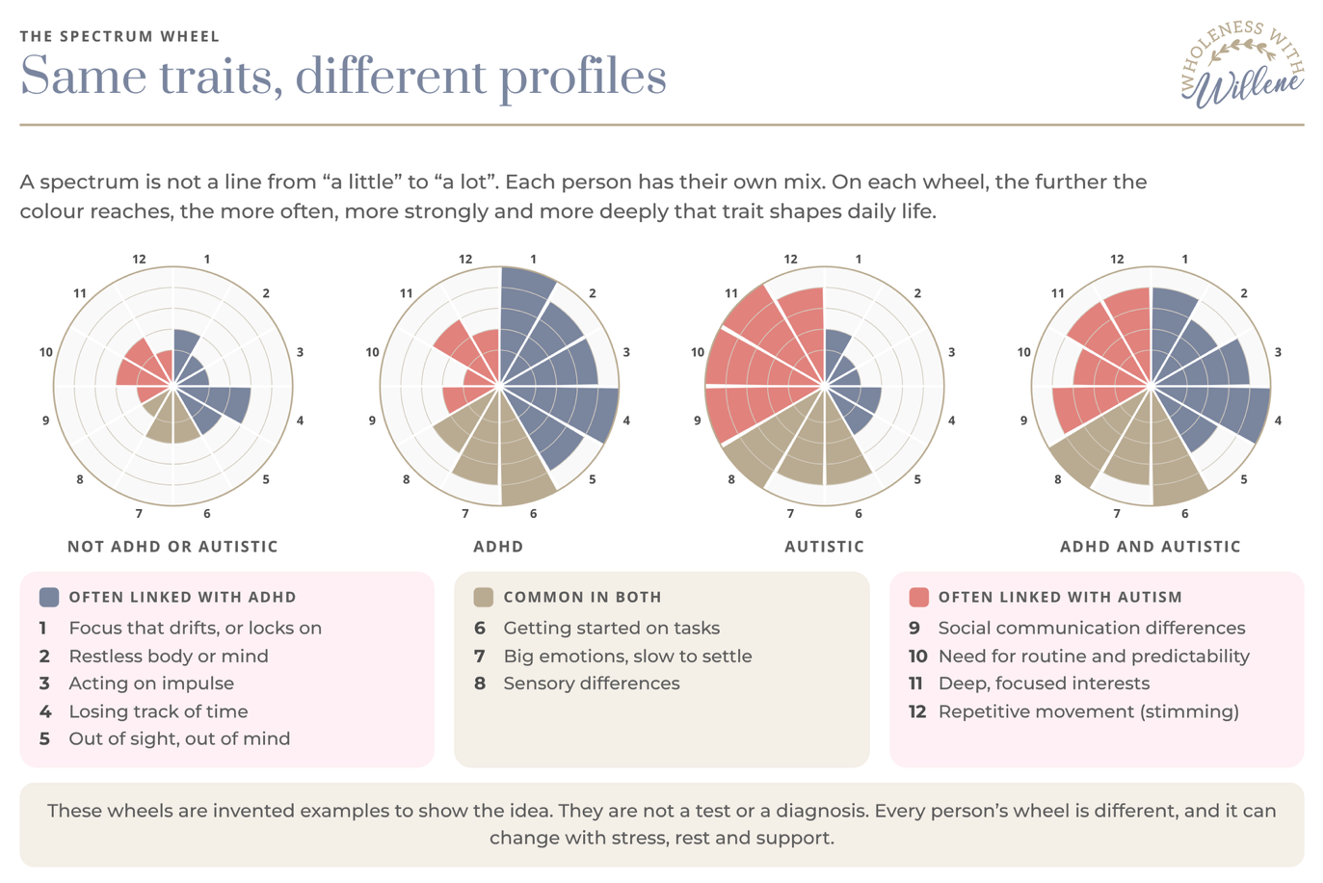 Some traits are often associated with ADHD, such as focus that drifts or locks on, a restless body or mind, and losing track of time. Some are often associated with autism, such as social communication differences, a need for routine and predictability, and deep, focused interests. Others, such as sensory differences and big emotions that are slow to settle, are common in both. Someone who is not ADHD or autistic might touch on a few of these lightly. An ADHD or autistic person lives with many of them, strongly, most days. And someone who is both ADHD and autistic has their own unique mix, not simply “more of everything”. The wheels in the image are examples to illustrate the idea. They are not a test or a diagnosis, and every person’s wheel can shift with stress, rest and support.
Real strengths, real disability
I always want to hold both of these simultaneously. Many adults with ADHD and autism describe real strengths, such as creativity, energy, deep focus and attention to detail (Sedgwick, Merwood & Asherson, 2019; Russell et al., 2019). Alongside this, ADHD and autism can be profoundly disabling. Everyday tasks often require far more effort. Burnout is common. Anxiety and depression are more prevalent than in the general population (Lai et al., 2019; Katzman et al., 2017). Support and understanding help a great deal, but they do not make the difficulties disappear. Honestly naming them is not negative. It is what makes the strengths and the support possible to see.
What to say next time
You do not owe anyone an explanation. But if you would like to respond, here is a gentle three-step script.
- Agree with what is true. “You’re right, lots of people have some of these traits.”
- Name the difference. “For me, it’s about how often, how strongly and how much it shapes my day. It’s most days, in most places; it has been that way since I was a child, and it makes everyday life much harder.”
- Invite curiosity. “If you’d like to understand it, ask me what it’s like for me.”
Starting with agreement helps the other person relax, making them more likely to listen to the rest. If you want an everyday comparison, try this one: Everyone gets a spot of drizzle now and then. Living with heavy rain most days is different: you plan, dress and build your whole life around it, and it wears you down. A spot of drizzle is not the same.
You are not imagining it
If this comment has ever made you doubt yourself, please hear this: the effort you put in every day is real, even when others cannot see it. I offer neuroaffirming, strengths-based counselling and life coaching for adults, in person in County Kildare, Ireland and online. If you would like support in understanding your own wheel, building on your strengths and finding ways through the hard parts, I would love to hear from you. You can get in touch through wholenesswithwillene.com.
References
- American Psychiatric Association (2022). Diagnostic and Statistical Manual of Mental Disorders, Fifth Edition, Text Revision (DSM-5-TR). APA
- Constantino, J. N. & Todd, R. D. (2003). Autistic traits in the general population: a twin study. Archives of General Psychiatry, 60(5), 524 to 530. PubMed
- Katzman, M. A. et al. (2017). Adult ADHD and comorbid disorders: clinical implications of a dimensional approach. BMC Psychiatry, 17, 302. BMC Psychiatry
- Lai, M. C. et al. (2019). Prevalence of co-occurring mental health diagnoses in the autism population: a systematic review and meta-analysis. The Lancet Psychiatry. PubMed
- Larsson, H. et al. (2012). Childhood attention-deficit hyperactivity disorder as an extreme of a continuous trait: a quantitative genetic study of 8,500 twin pairs. Journal of Child Psychology and Psychiatry, 53(1), 73 to 80. PubMed
- Russell, G. et al. (2019). Mapping the autistic advantage from the accounts of adults diagnosed with autism: a qualitative study. Autism in Adulthood. PMC
- Sedgwick, J. A., Merwood, A. & Asherson, P. (2019). The positive aspects of attention deficit hyperactivity disorder: a qualitative investigation of successful adults with ADHD. ADHD Attention Deficit and Hyperactivity Disorders. Springer