
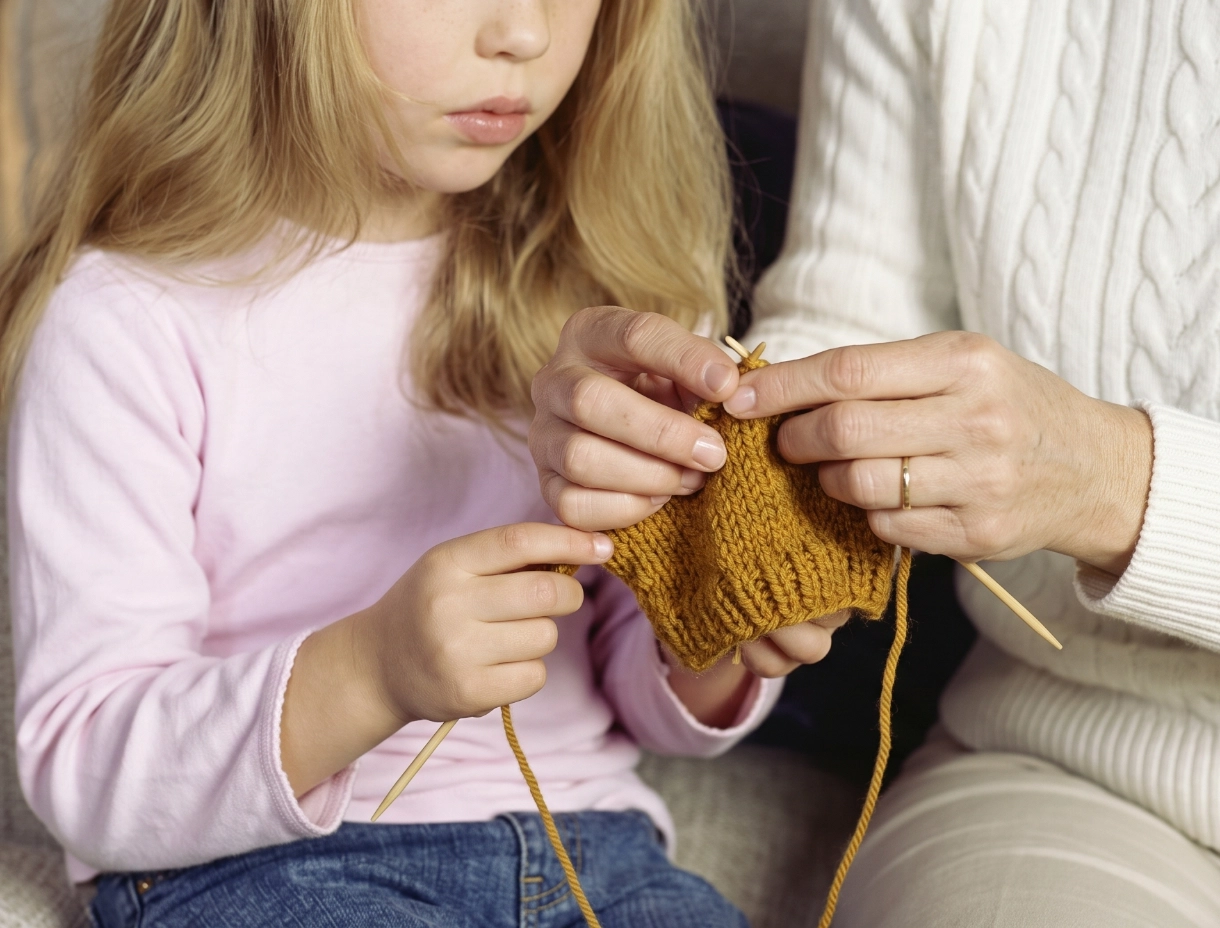
My Ouma (Afrikaans for grandmother) taught me to knit and crochet when I was five. She was, without question, my favourite person in the whole world. I have vivid memories of sitting beside her, hook in hand, more knots than stitches, while she patiently showed me the same movement again and again until it finally clicked.
When she passed away in 2013, I picked up a ball of yarn…. not because I had a project in mind, but because I needed something to do with my hands while my mind and heart caught up with the loss. What I found surprised me. Crocheting didn’t just give me something to focus on. It made me feel close to her again. Every stitch felt like a small, quiet conversation with someone I missed enormously.
There’s a reason why repetitive, rhythmic movement can be healing. Our nervous systems respond to patterned, predictable activity in a way that supports regulation, the same principle behind rocking, walking, or humming (Perry & Hambrick, 2008). Crochet gives your hands a steady, repeating rhythm to follow, which can help settle an overwhelmed or grieving nervous system when words alone can’t reach it. It also asks for just enough concentration to quiet a racing mind, without demanding more than you have to give on a hard day.
The research backs up what so many crafters already feel intuitively. A large international survey of knitters found strong associations between the craft and feelings of calm, happiness, and improved mood, particularly for those who knitted frequently (Riley, Corkhill, & Morris, 2013). Similar findings have emerged from research into quilting, linking the activity to a sense of achievement, connection to others, and improved wellbeing (Burt & Atkinson, 2012). Crochet, sharing much of the same rhythmic, tactile, creative quality, seems to offer many of the same benefits.
Thirteen years on, I’m still crocheting, and now I’m teaching others the way my Ouma once taught me. Every time I pass the skill on, it feels like her legacy keeps living, one stitch at a time.
I’ve also seen this play out among clients who use craft to build confidence, regulate difficult emotions, calm an anxious nervous system, or simply reconnect with creativity after a long stretch without it.
On a personal level, I’ve come to appreciate crochet as an acceptable way to stim in public. Repetitive hand movement helps me self-regulate, and there’s something quietly wonderful about a form of stimming that also produces a blanket.
Grief doesn’t ask permission before it visits, and it rarely leaves on a schedule. It also doesn’t always respond well to talking, at least not at first. Sometimes what helps most is something to do with your hands while everything else settles.
Thirteen years later, I can say that a hook, some yarn, and a little patience helped me hold onto someone I loved, one loop at a time, and gave me a way to pass a little of her on to everyone I teach.
References
Riley, J., Corkhill, B., & Morris, C. (2013). The benefits of knitting for personal and social wellbeing in adulthood: Findings from an international survey. British Journal of Occupational Therapy, 76(2), 50–57. https://doi.org/10.4276/030802213X13603244419077
Burt, E. L., & Atkinson, J. (2012). The relationship between quilting and wellbeing. Journal of Public Health, 34(1), 54–59. https://doi.org/10.1093/pubmed/fdr041
Perry, B. D., & Hambrick, E. P. (2008). The neurosequential model of therapeutics. Reclaiming Children and Youth, 17(3), 38–43.